

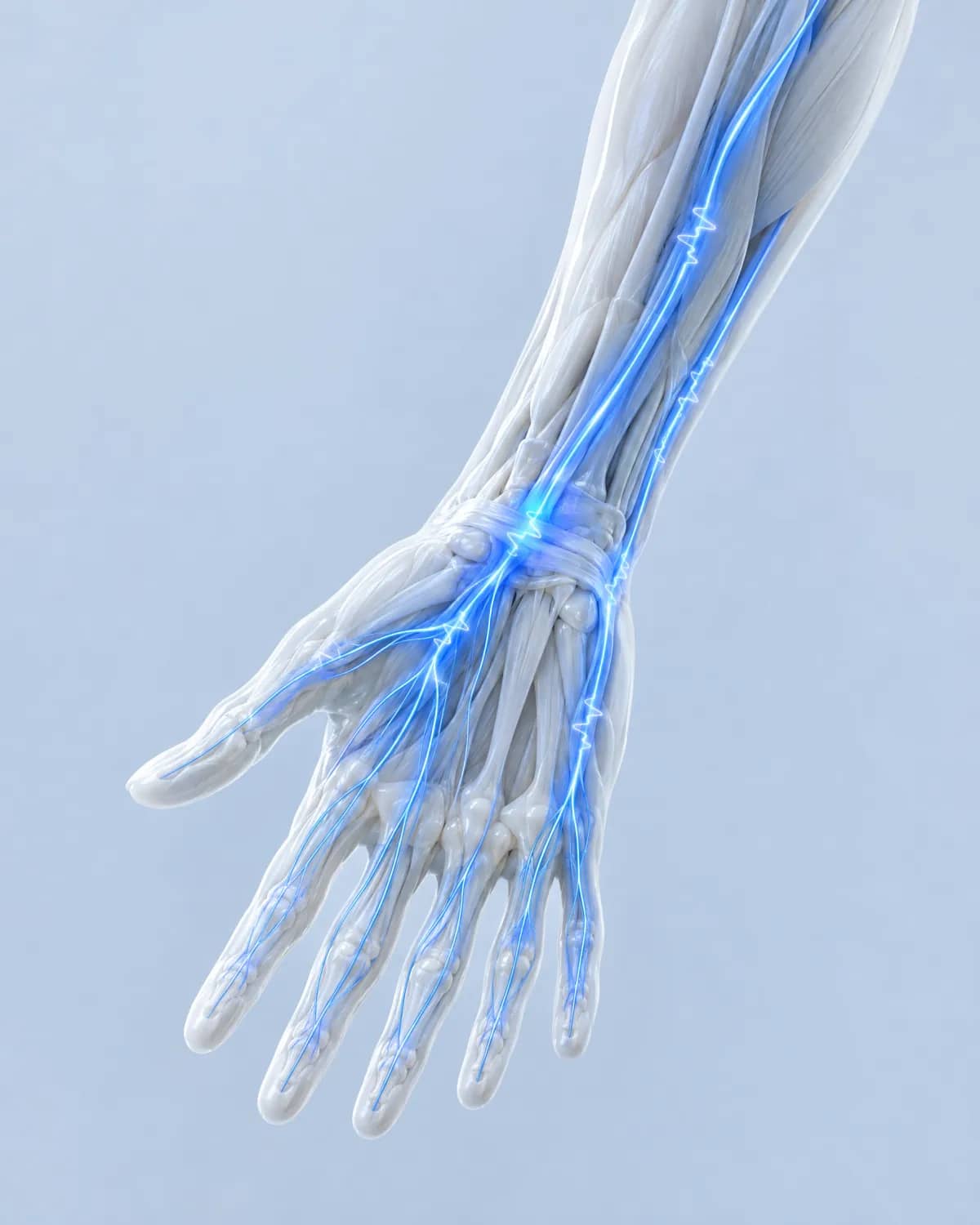
 Illustration · Where it works
EMG and Nerve Conduction Studies
Tests of nerve and muscle function that find the source of numbness, tingling or weakness.
EMG and nerve conduction studies are diagnostic tests that measure how well your nerves carry signals and how your muscles respond. They help find the source of numbness, tingling, weakness and some types of pain, such as a pinched nerve in the neck or back, carpal tunnel syndrome or peripheral neuropathy. Dr. Patel, who is board-certified in Physical Medicine and Rehabilitation, performs and interprets them to guide treatment.
- TypeDiagnostic
- Also calledEMG, NCS, Electromyography, Nerve conduction velocity test (NCV), Electrodiagnostic testing
Is it right for you?
A consultation with Dr. Patel confirms whether this treatment is the right fit.
How it works
Your nerves carry electrical signals from the spinal cord to your muscles, and from your skin back to the brain. When a nerve is pinched, damaged or diseased, those signals slow down, weaken or stop. Electrodiagnostic testing measures this directly. It looks at how nerves and muscles work, while X-rays and MRI show how they look. Together they give a clearer picture than either alone.
A nerve conduction study, or NCS, measures how fast and how strongly signals travel along a nerve. Small electrical pulses are given through pads on the skin, and sensors record the response further along the nerve or over the muscle it controls. Electromyography, or EMG, uses a very thin needle electrode to record the electrical activity of muscles at rest and as you tighten them. It shows whether muscles are getting normal signals from their nerves.
These tests help answer practical questions. Is the problem in a nerve root at the spine, a nerve in the arm or leg, or the muscle itself? Which nerve, at which level, and how severe is it? Is the damage new or old? The answers matter for carpal tunnel syndrome, a pinched nerve from a herniated disc, peripheral neuropathy and many other conditions, and they shape which treatment makes sense.
Electrodiagnostic medicine is a core part of training in Physical Medicine and Rehabilitation. Dr. Patel is board-certified in that specialty as well as in pain medicine, so he can connect test results directly to your exam and your treatment. If results suggest a condition best managed by another specialist, such as a neurologist or hand surgeon, he will explain the findings and coordinate the referral.
Your appointment, step by step
Testing usually takes 30 to 60 minutes, depending on how many nerves and muscles need to be checked.
Before the test
Dr. Patel reviews your symptoms and examines you to decide which nerves and muscles to test. Clean skin without lotion helps the pads stick. Tell the team if you take blood thinners or have a pacemaker or defibrillator.
Nerve conduction study
You lie on a table and small sensor pads are placed on the skin. A brief electrical pulse is applied over the nerve, which feels like a quick tap or snap. The machine records how fast and how strongly the signal travels. Skin temperature is checked, since cool limbs slow the readings.
EMG
A very thin, sterile needle electrode is placed into selected muscles. It records activity and does not deliver shocks. Dr. Patel watches and listens to the signals with the muscle relaxed, then while you tighten it.
Reviewing results
Dr. Patel interprets the findings, often during the visit, and explains what they mean. A written report goes into your record and to your referring doctor.
Going home
There is no sedation, so most people drive themselves home and return to normal activity right away.
After the procedure · Honest risks
- Most people return to normal activities right after the test.
- Mild muscle soreness where the needle was placed can last a day or two.
- Small bruises at needle sites are possible, especially for people taking blood thinners.
- There is no sedation, so you can usually drive yourself home.
- Results are discussed with you and used to shape your treatment plan.
- Brief discomfort from the electrical pulses and the needle
- Muscle soreness for a day or two
- Small bruises or minor bleeding at needle sites
- Rarely, infection at a needle site
- Very rarely, a puncture of the lung when muscles of the chest wall or upper back are tested
- Normal results do not rule out every nerve problem, such as small fiber neuropathy or a very recent injury
Questions
Does EMG hurt?
How do I prepare?
Why test nerves if I already had an MRI?
How soon after an injury can the test be done?
Can EMG show the cause of my pain?
This page explains a condition or treatment in general. It is not a diagnosis or medical advice for you. Dr. Patel will explain what applies to you at your visit.