




 Illustration · Where it works
Radiofrequency Ablation
Heat applied to small pain-carrying nerves to quiet joint pain in the spine, knee or hip for months.
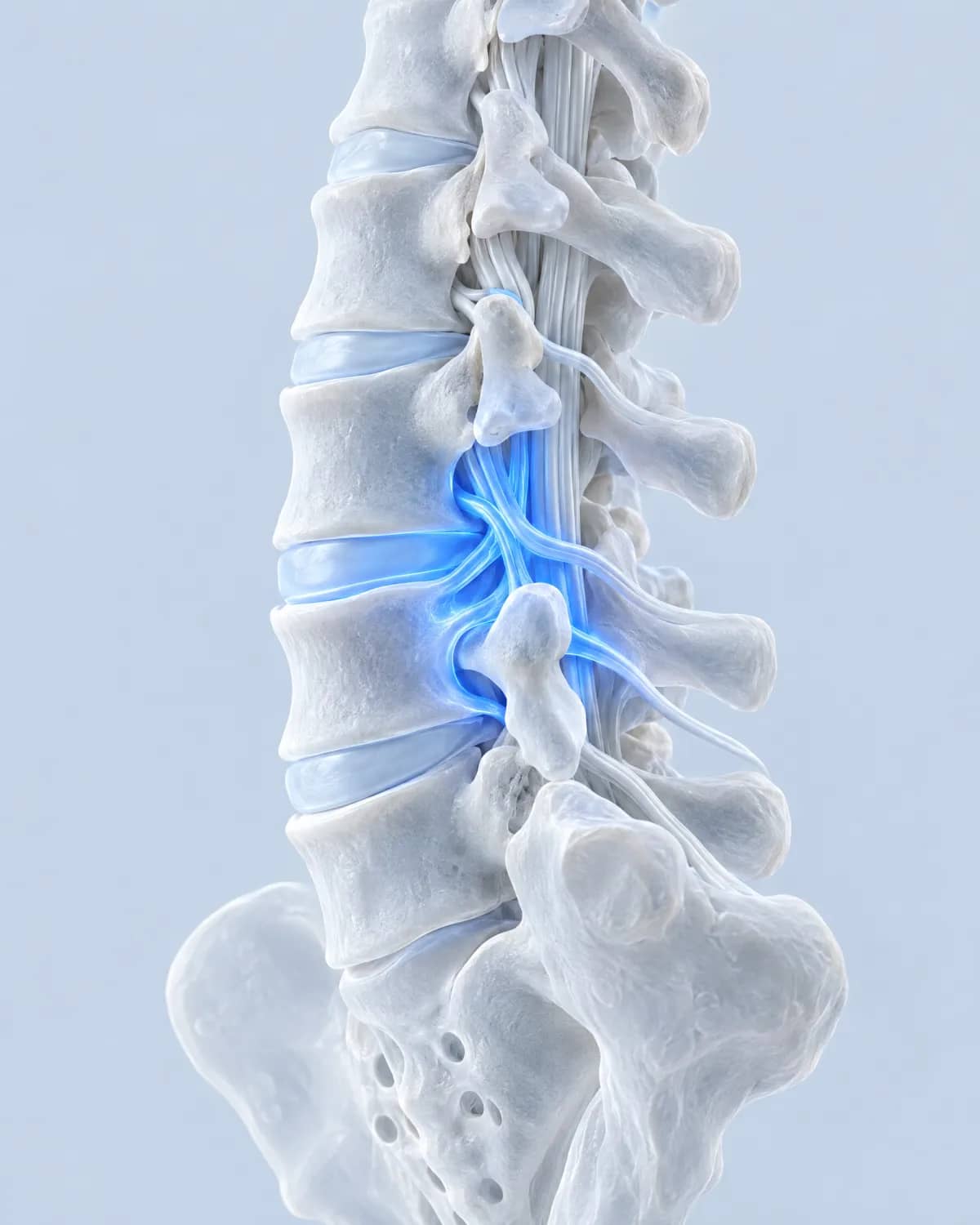
Radiofrequency ablation uses a heated needle tip to disable the small nerves that carry pain from specific joints, most often the facet joints of the spine. It usually follows diagnostic nerve blocks that confirm those nerves are the source. Relief often lasts many months, and because nerves can regrow, Dr. Patel may repeat it if it helped.
- TypeAblation
- GuidanceLive X-ray (fluoroscopy)
- Also calledRFA, Rhizotomy, Radiofrequency neurotomy
Is it right for you?
A consultation with Dr. Patel confirms whether this treatment is the right fit.
How it works
Pain from a joint reaches your brain through small sensory nerves. In the spine, the facet joints are supplied by nerves called medial branches. The knee, hip and sacroiliac joint have their own small nerves. When arthritis or injury makes a joint painful, these nerves keep sending signals. Radiofrequency ablation, also called rhizotomy, targets those nerves rather than the joint itself.
Using live X-ray, Dr. Patel places a thin, insulated needle beside each targeted nerve. Radiofrequency energy heats only the tip, creating a small, controlled lesion on the nerve. This interrupts its ability to carry pain signals. There is no incision, and the procedure is done in the office without opioids or open surgery. The larger spinal nerves that control your arms and legs are kept safely away.
Before ablation, you usually have diagnostic blocks, such as medial branch blocks, that briefly numb the same nerves. Clear relief from those blocks makes success with ablation more likely. Without that step, the result is far less predictable. This is why the process starts with testing and not with ablation.
Relief is not permanent. Treated nerves usually regrow over time, and pain may gradually return. For many people relief lasts several months to a year, and sometimes longer. If the first treatment helped, it can usually be repeated. Many people use the stretch of lower pain to rebuild strength and stay active.
Your appointment, step by step
Usually 30 to 60 minutes, depending on how many nerves are treated, plus time to check in and rest.
Diagnostic blocks first
After a full evaluation, including your history and imaging such as MRI or CT, you usually have one or two sets of diagnostic nerve blocks on separate days. Ablation is scheduled only if they give clear relief.
Preparation
You lie face down for spine treatments, or on your back for the knee. The skin is cleaned and numbed. If light sedation is used, you stay awake enough to answer questions during testing.
Placing the needles
Under live X-ray, Dr. Patel guides each thin, insulated needle to its nerve and checks the position from more than one angle.
Safety testing
A small electrical signal confirms the position. You may feel tingling or pressure in your usual pain area, or a twitch in the small back muscles. Dr. Patel checks that the arm or leg does not twitch, which confirms the larger nerves are clear.
Ablation
Numbing medicine is placed at each site. The tip is then heated for about a minute or two at each spot. You may feel warmth or pressure.
Rest and home
You rest briefly, then go home the same day with written instructions and someone to drive you.
After the procedure · Honest risks
- Soreness at the treatment sites for a few days is common. Ice packs often help.
- Some people notice burning or sunburn-like sensitivity over the area for a few weeks. This usually settles on its own.
- Relief is usually not immediate. It often builds over two to four weeks.
- Most people return to normal daily activities the next day. Avoid strenuous activity for a few days.
- Avoid soaking in a bath, hot tub or pool for a day or two.
- Physical therapy or a home exercise program helps you make the most of the relief.
- Soreness, bruising or swelling at the needle sites
- Temporary burning, numbness or skin sensitivity over the treated area (neuritis)
- Pain that returns as the nerves regrow, usually after months
- Infection or bleeding, which are rare
- Rarely, injury to a nearby nerve, causing numbness or weakness
- Rarely, a skin burn at the needle site or grounding pad
Questions
Is radiofrequency ablation permanent?
Will it affect my strength or movement?
Why do I need nerve blocks first?
Is this the same as rhizotomy for trigeminal neuralgia or spasticity?
Can I have it if I have a pacemaker or another implanted device?
This page explains a condition or treatment in general. It is not a diagnosis or medical advice for you. Dr. Patel will explain what applies to you at your visit.

Treatments
Epidural Steroid Injections
A steroid injection near irritated spinal nerves to calm pain that travels into the arm or leg.

Selective Nerve Root Block
A precise injection at one spinal nerve root to find and treat the source of arm or leg pain.

Facet Joint Injections
Medicine placed in a small spinal joint to find and ease arthritis pain in the neck or back.