




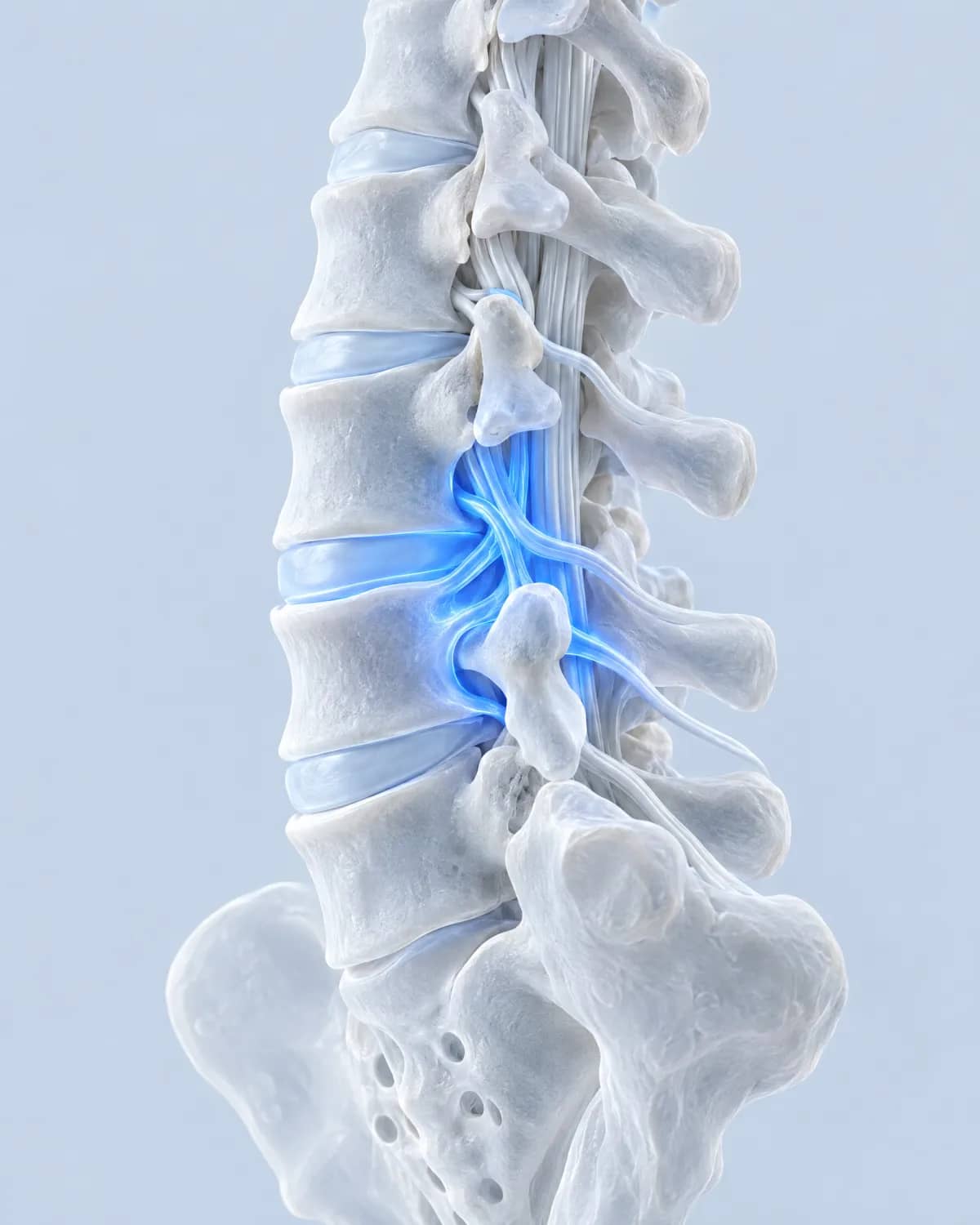
 Illustration · Where it works
Epidural Steroid Injections
A steroid injection near irritated spinal nerves to calm pain that travels into the arm or leg.
An epidural steroid injection places anti-inflammatory steroid medicine into the epidural space, the area around the spinal nerve roots, to calm nerve irritation. It is most often used for pain that travels into an arm or leg from a herniated disc or spinal stenosis. Dr. Patel recommends it when therapy, activity changes and medication have not given enough relief, and he performs every injection under live X-ray guidance.
- TypeInjections
- GuidanceLive X-ray (fluoroscopy) with contrast dye
- Also calledEpidural injection, ESI, Interlaminar, transforaminal or caudal epidural
Is it right for you?
A consultation with Dr. Patel confirms whether this treatment is the right fit.
How it works
Your spinal cord is a bundle of nerves that runs from the brain down through the spine. At each level, nerve roots branch off and travel to your arms, legs and trunk. Around them is a protective layer of fat and small blood vessels called the epidural space. When a disc, a bone spur or a narrowed canal pinches or inflames a nerve root, pain, tingling or numbness can travel along that nerve.
An epidural steroid injection places a corticosteroid, often with a numbing medicine, into the epidural space close to the irritated nerve. The steroid reduces inflammation around the nerve root. Less inflammation often means less pain, which gives the nerve time to settle and can let you move more and make progress in physical therapy. The injection does not remove a disc or widen the canal. It calms the irritation those problems cause.
How long relief lasts varies. Some people feel better for weeks, others for many months, and for some the flare settles and does not return. Others get little benefit. A good response also supports the idea that an inflamed nerve root is driving your pain, which helps guide what comes next.
Dr. Patel chooses one of three routes based on your anatomy and symptoms. An interlaminar injection enters from the back, between two vertebrae. A transforaminal injection reaches one nerve root where it exits the spine. A caudal injection enters through a small natural opening near the tailbone. Each one is done under live X-ray, with contrast dye to confirm the medicine is going where it should.
Your appointment, step by step
The procedure itself usually takes under 30 minutes, plus time to check in and a short rest before you go home.
Check-in and review
We confirm your history, allergies, and any blood thinners or diabetes medicines. Any blood thinner change is planned ahead with the prescribing doctor. Dr. Patel reviews your imaging and answers questions before you sign consent.
Positioning
You lie face down on a padded table, or sometimes on your side. For a neck injection, a pillow supports your chest. The skin is cleaned with antiseptic.
Numbing the skin
Local anesthetic numbs the skin. It stings for a few seconds, then most people feel only pressure.
Guiding the needle
Using live X-ray, Dr. Patel guides a thin needle into the epidural space. A small amount of contrast dye confirms the needle position and shows how the medicine will spread.
Injecting the medicine
The steroid, often mixed with numbing medicine or saline, is injected slowly. You may feel pressure or a brief, familiar ache in the arm or leg. The needle is removed and a small bandage is applied.
Short rest and going home
You rest for a short time while we check how you feel. You go home the same day with written instructions, ideally with someone to drive you.
After the procedure · Honest risks
- Take it easy for the rest of the day. Most people return to usual activities the next day.
- Soreness at the injection site for a day or two is common. An ice pack can help.
- The numbing medicine may ease pain for a few hours. Pain may return before the steroid starts working, which is normal.
- The steroid usually starts working within 2 to 7 days, and sometimes takes up to two weeks.
- If you have diabetes, check your blood sugar more often for a few days, since steroids can raise it.
- Keep a simple pain diary. It helps Dr. Patel judge how well the injection worked.
- Physical therapy often begins or continues once the pain eases.
- A temporary increase in pain or soreness for a few days
- Short-term steroid effects such as flushing, trouble sleeping, mood changes or raised blood sugar
- A headache if the needle punctures the sac around the spinal fluid, which is uncommon and usually improves with rest and fluids, or with treatment if it persists
- Infection or bleeding, which are rare
- Allergic reaction to the contrast dye or medicine
- Rarely, nerve injury, and very rarely, serious complications such as spinal cord injury or stroke, mainly reported with injections in the neck
- Repeated steroid doses over time can affect bone density and blood sugar, which is why the number of injections per year is limited
Questions
Does an epidural steroid injection hurt?
How long will the relief last?
How many epidural injections can I have?
Is this the same as the epidural used during childbirth?
Can an epidural injection help me avoid surgery?
This page explains a condition or treatment in general. It is not a diagnosis or medical advice for you. Dr. Patel will explain what applies to you at your visit.

Treatments

Facet Joint Injections
Medicine placed in a small spinal joint to find and ease arthritis pain in the neck or back.

Joint Injections
Medicine placed in or around a painful knee, hip, shoulder or other joint to ease pain and inflammation.

Trigger Point Injections
Small injections into tight, tender muscle knots to help the muscle relax and ease pain.